
Legal & Tax Disclosure
ATTORNEY ADVERTISING.
This article is provided for general informational purposes only and does not constitute legal, financial, or tax advice.
Reading this content does not create an attorney-client or professional advisory relationship.
Laws vary by jurisdiction and are subject to change. You should consult a qualified professional regarding your specific circumstances. |
T-bone and intersection crashes in San Diego are governed by California Vehicle Code § 21453 and § 21800, where liability pivots on the technical sequence of right-of-way and signal timing. In 2026, the rise of automated intersection sensors across San Diego has transformed how “failure to yield” is litigated. At Morse Injury Law, we move beyond witness statements to secure electronic traffic signal records and pre-crash EDR data to prove the precise moment of impact. Whether your collision occurred in a high-traffic zone like Fashion Valley or a residential intersection, we build trial-ready files for San Diego Superior Court. We focus on the “Mechanism of Injury” specific to side-impact physics—identifying axonal shearing and internal trauma that standard insurance adjusters often overlook in their early settlement offers.
Jason enters an intersection in Clairemont on a stale green, and a car blows through from the cross street and hits him square in the driver-side door. The other driver immediately says, “It was yellow,” and a witness starts drifting away before anyone gets a name. Before the night is over, the tow yard, ER imaging, and missed work are already at $27,430.
T-bone & intersection crashes in San Diego: what do you have to do first under California Law to protect the claim?
Lock down the intersection proof before it turns into a “he said/she said” fight. Under California Law, liability at intersections is built on right-of-way rules and objective timing, and your claim value depends on whether you can prove signal phase, approach speed, and point of impact before the defense story hardens.
What I see in real San Diego intersection cases, and how the defense tries to price them
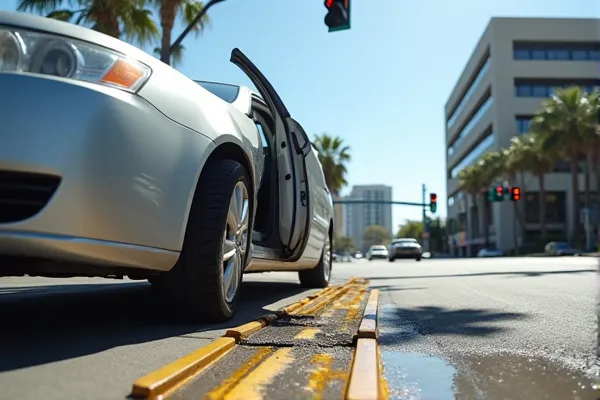
The first week after a side-impact collision is when the case gets silently assigned a number. I know the insurer playbook because I have been trained by people who used to defend these claims: they want uncertainty, and they want it early. So they lean into “late yellow,” “unavoidable,” and comparative fault narratives, then use that uncertainty to justify a discount.
A realistic San Diego scenario: a driver turns left across traffic near Mission Valley, a straight-through vehicle enters on a changing light, and the T-bone happens in the middle of the box. Within days, the insurer argues shared blame, attacks speed, and tries to frame the impact as “angle contact,” not a true broadside, because broadside injuries tend to be more serious. If the facts support it, we build the file like it is going to San Diego Superior Court, because intersection cases only settle at fair value when the defense believes their story will be tested against objective proof and consistent medical records.
- Liability anchor: right-of-way and signal compliance under Veh. Code § 21453 and Veh. Code § 21801.
- Conduct anchor: unsafe movement and speed-for-conditions under Veh. Code § 22107 and Veh. Code § 22350.
- Negligence backbone: responsibility under Civ. Code § 1714.
Why California Law and San Diego Superior Court venue change leverage in intersection collisions
Intersection crashes are defended as timing disputes, and timing disputes are priced on proof. Under California Law, negligence is still anchored to Civ. Code § 1714, but right-of-way rules define what “reasonable care” looks like in a controlled intersection.
Venue matters because it forces the defense to commit, preserve, and explain. In San Diego Superior Court, the case stops being an adjuster narrative and starts being a record-based dispute where inconsistencies get exposed. And the filing deadline is real, regardless of how long an insurer claims it needs to “complete its investigation,” under CCP § 335.1.
The “Immediate 5”: questions San Diego victims ask after a T-bone or intersection crash
1) If the other driver ran a red light in San Diego, what rule actually governs fault?
The core rule is signal compliance under Veh. Code § 21453, and the practical fight is proving the phase when each vehicle entered. If you cannot prove timing with physical evidence and witness consistency, insurers will try to convert a red-light violation into “late yellow” uncertainty and discount the claim.
2) In a San Diego left-turn T-bone, how does California Law treat the turning driver?
A driver turning left has a duty to yield to oncoming traffic close enough to be a hazard under Veh. Code § 21801. The defense will still look for comparative fault angles, but the legal starting point is that the turning movement carries the yield obligation, and the proof lives in impact geometry and timing.
3) What if the crash happened at a stop sign or uncontrolled intersection in San Diego?
Stop-controlled right-of-way is governed by Veh. Code § 21802, and uncontrolled intersections are generally governed by Veh. Code § 21800. In practice, insurers attack these cases by disputing who arrived first and who had the right of way, which is why scene documentation and witness identification matter immediately.
4) If the insurer claims I changed lanes or moved unsafely right before the impact, what statute do they use?
Unsafe turning or lane movement is commonly framed under Veh. Code § 22107. The real issue is whether the vehicle dynamics and damage patterns support that claim, because side-impact crashes often get mischaracterized to manufacture shared fault and reduce value.
5) How long do I have to file an intersection crash case in San Diego, and why does waiting hurt these cases?
In many California personal injury cases, the limitations period is set by CCP § 335.1. Waiting is dangerous because intersection cases depend on perishable proof like witness memory and scene conditions, and insurers are trained to exploit evidence gaps as “uncertainty” that justifies a lower valuation.

Side-impact collisions cause outsized injury risk because the occupant has less structural buffer. The defense knows that, so the first objective is to dilute liability and frame the impact as minor or shared.
- Timing proof: signal phase and entry timing drive liability at controlled intersections.
- Geometry proof: point of impact and crush patterns either confirm or destroy the defense narrative.
- Speed proof: “too fast for conditions” arguments land under Veh. Code § 22350 when supported by facts.
Magnitude expansion: what actually moves a San Diego intersection case
A) Evidence Evaluation in San Diego Cases
Police reports help identify involved parties and capture early statements, but intersection cases rise or fall on objective proof. I compare the report against scene photos, vehicle damage and crush, medical records, and a clean timeline of symptoms and treatment. When the evidence is thin, insurers price the claim as a timing dispute, not a liability case.
- Police reports vs medical records: the report describes the event; the records prove injury progression and consistency.
- Scene photos vs repair documentation: photos show lane positions and signal context; repairs show impact energy and direction.
- Treatment timeline consistency: gaps get exploited as “unrelated” or “resolved” arguments.
B) Settlement vs Litigation Reality
Before filing, an adjuster can keep the file in “evaluation” while building a comparative fault narrative around uncertainty. Once a case is filed in San Diego Superior Court, the defense has to commit to specific positions, and vague claims about timing and visibility face real scrutiny. The deadline pressure is not a threat; it is procedure, and it is governed by CCP § 335.1.
C) San Diego-Specific Claim Wrinkles
San Diego intersections combine high traffic volume, short merge windows, and aggressive signal cycles that create predictable collision patterns. The common resistance pattern is also predictable: “yellow light,” “unsafe movement,” and “you were speeding,” aimed at reducing liability certainty. The response is disciplined proof tied to right-of-way rules like Veh. Code § 21453 and yield rules like Veh. Code § 21801.
- Traffic density and rear-end patterns: congestion causes sudden stops and risky merges approaching intersections.
- Multi-vehicle freeway collisions: post-impact spinouts can pull additional vehicles into the intersection zone.
- Common Southern California insurer resistance patterns: comparative fault framing, “minor impact” messaging, and selective interpretation of statements.
Verified Outcomes or Lived Experiences
Kimberly
“They kept repeating that the light was yellow and blamed me for entering too late. Once the impact point and timeline were laid out clearly, the story changed and the negotiations finally matched the facts.”
Brandon
“The insurer pushed hard on shared fault and tried to minimize my injuries. When everything was documented consistently and the right-of-way rules were applied correctly, the stalling stopped and the case moved forward.”
California Statutory Framework & Legal Authority
Attorney Advertising, Legal Disclosure & Authorship
ATTORNEY ADVERTISING.
This content is provided for general informational and educational purposes only and does not constitute legal, financial, or tax advice.
Under the California Rules of Professional Conduct and State Bar advertising regulations, this material may be considered attorney advertising.
Reading this content does not create an attorney-client relationship or any professional advisory relationship.
Laws vary by jurisdiction and are subject to change, including recent 2026 developments under California’s AB 2016 and evolving federal estate and reporting requirements.
You should consult a qualified attorney or advisor regarding your specific circumstances before taking action.
Responsible Attorney:
Richard Morse, California Attorney (Bar No. 289241).
Morse Injury Law is a practice location and trade name used by Richard Peter Morse III, a California-licensed attorney.
About the Author & Legal Review Process
This article was researched and drafted by the Legal Editorial Team of Richard Peter Morse III,
a collective of attorneys, legal writers, and paralegals dedicated to translating complex legal concepts into clear, accurate guidance.
Legal Review:
This content was reviewed and approved by Richard Morse, a California-licensed attorney (Bar No. 289241).
Mr. Morse concentrates his practice in estate planning and estate administration, advising clients on proactive planning strategies and representing fiduciaries in probate and trust administration proceedings when formal court involvement becomes necessary.
With more than 13 years of experience in California personal injury law,
Mr. Morse focuses on structuring enforceable estate plans, guiding fiduciaries through court-supervised proceedings,
resolving creditor and notice issues, and coordinating asset management to support compliant, timely distributions and reduce fiduciary risk. |