
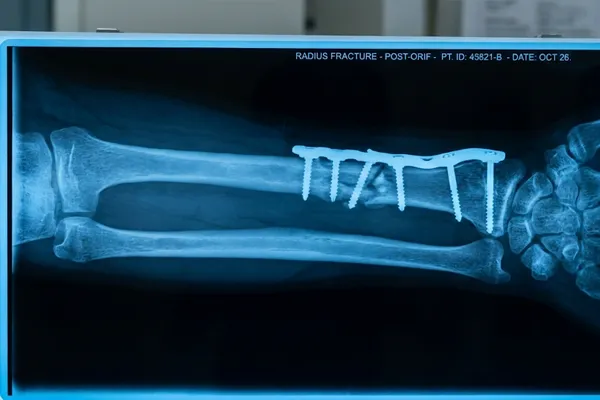
Insurance adjusters value broken bones based on “healing time.” But if your bone was shattered (Comminuted Fracture) or pierced the skin (Compound Fracture), a simple cast is not enough. You likely required Open Reduction Internal Fixation (ORIF)—surgery where doctors install titanium plates, rods, and screws to rebuild the bone. This hardware is often permanent. We ensure your settlement pays for the surgery and the future risk of arthritis or hardware removal.
Bone fracture lawyer in San Diego: what do you do when the insurer calls it “just a break” but your life is on pause?
The single most important rule under California Law is to preserve objective proof early—incident evidence, imaging, and wage documentation—because fracture cases get discounted the moment the defense can argue “routine healing” and “no permanent impairment.”
How fracture cases actually get fought in San Diego—after the swelling goes down and the adjuster starts minimizing
In my world, bone fracture cases are rarely about whether a bone broke. They’re about how it broke, what the imaging shows over time, and whether the mechanism matches the story the defense wants to sell. The carrier’s favorite move is to concede an “injury” while disputing causation, severity, or duration.
In an anonymized San Diego case, a worker suffered a tib/fib fracture when a vendor’s unsecured pallet shifted during a delivery. The claim was treated like a basic fracture with “expected recovery,” until we built a clean record for San Diego Superior Court under California Law: pre-incident activity, immediate symptoms, imaging chronology, operative reports, and a wage-loss trail that wasn’t speculative. Once the documentation was organized and discoverable, the valuation stopped being a guess.

Fractures that insurers routinely undervalue usually share one or more of these features:
- Displacement, comminution, or intra-articular involvement that changes long-term function.
- Surgery (ORIF, pins/plates/screws) and a documented rehab timeline.
- Complications: delayed union, nonunion, infection, hardware failure, or chronic pain patterns.
When liability is contested, we anchor duty and breach through Civ. Code § 1714 and then prove damages with records the defense can’t hand-wave away.
Why California Law and San Diego Superior Court venue change leverage in fracture claims
San Diego fracture cases often start with a slow-walk: “we’re investigating,” “we need records,” “we’re evaluating comparative fault.” That’s claims handling strategy, not medicine. Venue matters because filing in San Diego Superior Court forces the defense into formal discovery obligations instead of open-ended delay.
With discovery scope under CCP § 2017.010, document demands under CCP § 2031.010, and depositions under CCP § 2025.010, we can lock down footage, maintenance logs, training, incident reports, and the medical timeline before it gets “interpreted” by defense experts.
The “Immediate 5”: fracture questions that decide value and survivability in San Diego
1) What evidence matters most in a San Diego fracture claim before anyone talks settlement?
Start with objective proof: incident documentation, photos/video, witness IDs, and a medical timeline anchored by imaging. Under Civ. Code § 1714, you still need to prove breach and causation, and the defense will hunt for “intervening causes” or a delayed treatment gap. If the claim may be litigated, you build it like it will be filed in San Diego Superior Court, because that’s where your evidence has to hold up.
2) How do California deadlines apply to fracture injuries if the injury happened months ago?
Most personal injury claims are governed by the two-year statute in CCP § 335.1. That sounds generous until you realize key evidence disappears fast: surveillance loops overwrite, incident reports get “lost,” and witnesses move on. In San Diego, delay is a valuation killer even before it becomes a statute problem.
3) What’s the difference between a “simple fracture” and a fracture that changes case value?
Value changes when the fracture changes function: displaced or intra-articular fractures, surgical fixation, prolonged non-weight-bearing, and complications like nonunion or hardware failure. The defense will label it “routine healing,” then use gaps in therapy or inconsistent notes to argue the problem is “non-compliance.” Your job is to make the medical chronology and restrictions coherent and provable.
4) How does comparative fault get used against fracture victims in San Diego cases?
Comparative fault is a standard reduction play: footwear, where you were looking, whether you “should have seen” a hazard, or whether you “used the equipment correctly.” Under Civ. Code § 1431.2, allocation issues can materially change non-economic exposure, and insurers treat that as leverage. The practical response is evidence: scene documentation, maintenance logs, training records, and consistent medical notes tied to the mechanism of injury.
5) What changes once we file a fracture case in San Diego Superior Court?
Filing activates the discovery engine: broad scope under CCP § 2017.010, documents under CCP § 2031.010, and depositions under CCP § 2025.010. That matters because the defense can no longer “investigate” indefinitely; they must respond, produce, and commit to positions you can test under oath.
In fracture cases, I look for the pivot points that move value from “injury acknowledged” to “damages proven”:
- Mechanism proof: footage, photos, measurements, and maintenance history.
- Imaging chronology: initial films, follow-up imaging, surgical imaging, and radiology impressions.
- Functional restrictions: work notes, PT/OT progress, and objective limits tied to the fracture type.
The defense discounts what it can’t verify. My job is to make the fracture case verifiable.
Magnitude expansion: how bone fracture claims get evaluated and fought in San Diego
A) Evidence Evaluation in San Diego Cases
Fractures are medical-record cases first, liability cases second—because liability without damages proof still settles small. We weigh the fracture pattern against the incident mechanism and look for clean continuity: symptoms, imaging, treatment decisions, and rehab compliance.
- Medical records: ER notes vs ortho notes vs operative reports for consistency.
- Imaging: radiology impressions and follow-up films to track healing or complications.
- Work loss: payroll records and restrictions that align with the timeline.
B) Settlement vs Litigation Reality
Before filing, insurers negotiate with uncertainty. After filing in San Diego Superior Court, they negotiate with exposure and deadlines. That difference is why discovery tools matter: they force production of evidence and narrow defense narratives.
- Formal discovery prevents “we never received that” games.
- Depositions lock in what the defendant knew and what they did about it.
- Medical chronology becomes demonstrable, not debatable.
C) San Diego-Specific Claim Wrinkles
San Diego injury files frequently involve crowded venues, fast-moving traffic corridors, and layered defendants—property managers, vendors, contractors, delivery companies. Insurers exploit that complexity to delay responsibility and push comparative fault narratives.
- Traffic density and rear-end patterns create “minor impact” arguments even with real fractures.
- Multi-vehicle freeway collisions complicate causation and sequencing of impacts.
- Common Southern California resistance patterns include delayed acceptance and early lowball offers.
Lived Experiences
Sydney
“They kept calling it a ‘standard fracture’ and acted like I’d be fine in a few weeks. Richard focused on the imaging timeline and the work restrictions, and the tone changed once the insurer couldn’t minimize the records anymore.”
Logan
“The adjuster blamed me for everything and offered a number that didn’t even cover my time off. Richard built the evidence file and pushed it like a trial case, and the final outcome actually matched what the injury cost me.”
California Statutory Framework & Legal Authority
|
Attorney Advertising, Legal Disclosure & Authorship
ATTORNEY ADVERTISING.
This content is provided for general informational and educational purposes only and does not constitute legal advice.
Under the California Rules of Professional Conduct and applicable State Bar of California advertising regulations,
this material may be considered attorney advertising.
Viewing or reading this content does not create an attorney-client relationship.
Laws and procedures governing personal injury claims vary by jurisdiction and may change over time.
You should consult a qualified California personal injury attorney regarding your specific situation before taking any legal action.
Responsible Attorney:
Richard Morse, California Attorney (Bar No. 289241).
Morse Injury Law is a practice name and location used by Richard Peter Morse III, a California-licensed attorney.
About the Author & Legal Review Process
This article was prepared by the legal editorial team supporting Richard Peter Morse III,
with the goal of explaining California personal injury law and claims procedures in clear, accurate, and practical terms for injured individuals in San Diego and surrounding communities.
Legal Review:
This content was reviewed and approved by Richard Morse, a California-licensed attorney (Bar No. 289241),
who concentrates his practice on personal injury litigation and insurance claim disputes.
With more than 13 years of experience representing injury victims throughout California,
Mr. Morse focuses on serious personal injury matters including motor vehicle collisions, uninsured and underinsured motorist claims,
premises liability, catastrophic injury, and wrongful death.
His practice emphasizes claims evaluation, insurance carrier accountability, and litigation in California courts when fair resolution cannot be achieved.
|