
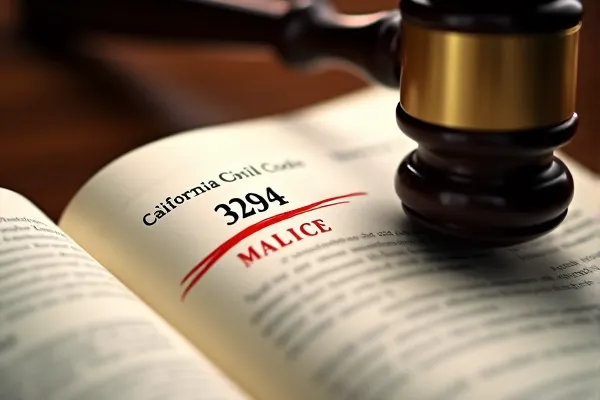
Standard damages are meant to make you “whole.” Punitive Damages (Civil Code § 3294) are meant to punish the defendant. To get them, we must prove “Malice,” “Oppression,” or “Fraud.” Under the landmark case Taylor v. Superior Court, California law holds that driving under the influence constitutes “Willful and Conscious Disregard” for human life. This allows us to sue for damages above and beyond standard insurance limits, targeting the driver’s personal assets.
Punitive damages for a drunk driver in San Diego: what does Civil Code § 3294 actually require?
The single most important rule under California Law is this: punitive damages are not “extra money because you’re angry”—they require proof, by a higher standard, that the defendant acted with malice, oppression, or fraud under Civ. Code § 3294.
What punitive damages look like in a real San Diego drunk-driving case
I’ve seen this play out the same way for years. You’d think a DUI crash would settle like a confession. It doesn’t. The defense tries to narrow the story, slice off “recklessness,” and pay only what they consider baseline general damages under Civ. Code § 3333.
In an anonymized San Diego case, the driver was arrested under Veh. Code § 23152 after a freeway drift and impact. We filed in San Diego Superior Court because punitive damages are litigated like a credibility war: what the driver knew, what they chose to do anyway, and what the evidence proves when you strip away excuses. The strategy was simple—build the “conscious disregard” record cleanly, then force the defense to defend it under oath.
Here’s what actually moved the case in the right direction:
- Law enforcement documentation: arrest narrative, observed impairment indicators, and the sequence of decisions.
- Timeline discipline: drinking window, driving window, collision window, medical onset, treatment progression.
- Framing: not “bad judgment,” but “knowing risk and doing it anyway,” which is the punitive theme under Civ. Code § 3294.
- Defense pressure points: when they realize a San Diego jury won’t like the choices made, the math changes.
Why California Law and San Diego Superior Court venue change leverage on punitive damages
Punitive damages aren’t awarded because the facts feel ugly. They’re awarded when the evidence meets the statutory definition, and when the defense knows that a jury in San Diego Superior Court will see the conduct as more than carelessness. Filing changes leverage because discovery forces the defendant’s story to harden—then you test it against records.
And the procedural clock matters. Your underlying personal injury case must still be timely under CCP § 335.1. If you lose the case, you lose the punitive claim with it—no matter how strong the DUI narrative is.
The “Immediate 5”: punitive-damages questions San Diego victims ask after a DUI crash
1) Does a drunk driver automatically owe punitive damages in California?
No. Civ. Code § 3294 requires proof of malice, oppression, or fraud, and it raises the proof burden above the “more likely than not” standard used for ordinary negligence damages under Civ. Code § 3333. A DUI arrest under Veh. Code § 23152 is strong evidence, but punitive damages still have to be proven with a clean, trial-ready record.
2) What evidence actually supports “malice” or “conscious disregard” in a San Diego DUI case?
We build punitive exposure around decisions and warnings: the drinking pattern, the choice to drive, the manner of driving, and what the defendant said and did before and after impact. An impairment case becomes punitive-ready when you can show the defendant knowingly took a high probability of harm and proceeded anyway—exactly the theme that fits Civ. Code § 3294 in real litigation.
3) If the DUI caused serious injury, does that change punitive damages analysis?
It can, but the hook is still the defendant’s state of mind and choices—not the size of your medical bill. A felony-type injury case often overlaps with Veh. Code § 23153, and that tends to strengthen the “reckless disregard” narrative. The defense will still try to separate impairment from causation, so we tie the DUI conduct to the collision mechanics and medical timeline.
4) What deadlines apply if I want to pursue punitive damages for a drunk driver?
Punitive damages are not a separate lawsuit with a separate clock. They ride with the personal injury claim, which generally must be filed within two years under CCP § 335.1. In San Diego practice, waiting also risks losing the best evidence: surveillance from nearby businesses, witness contact info, and clean recollections of the defendant’s behavior.
5) What changes once we file in San Diego Superior Court against a drunk driver?
Filing forces the defense to litigate the conduct, not just negotiate a number. In San Diego Superior Court, punitive damages push the case into a different posture: the defendant’s choices become a central issue, and the defense has to decide whether they want a jury hearing them explain those choices under the standards of Civ. Code § 3294. That risk—handled correctly—often changes what they’re willing to pay to resolve the case.
There’s a reason insurers try to keep DUI crashes “ordinary.” Punitive damages threaten their playbook, so they push familiar themes early:
- Minimize the conduct: “mistake,” “momentary lapse,” “wasn’t that impaired.”
- Dispute causation: “the crash would’ve happened anyway.”
- Attack the record: “no reliable proof,” “no clear timeline,” “inconsistent statements.”
- Control the narrative: settle fast, before the punitive evidence is organized.
If you’re pursuing punitive damages, your case can’t be a pile of records. It has to be a coherent, date-stamped story that a jury would believe.
Magnitude expansion: how punitive exposure changes evidence, leverage, and settlement in San Diego
A) Evidence Evaluation in San Diego Cases
Punitive claims live and die on the quality of proof. We treat evidence like it’s going to be read out loud in a courtroom, because it might be.
- Police reports vs medical records: we align the impairment narrative with the collision mechanics and injury timeline.
- Scene photos vs repair documentation: we prevent “minor damage” arguments from erasing a serious DUI risk profile.
- Treatment timeline consistency: we protect credibility so the defense can’t reframe everything as “overstated.”
B) Settlement vs Litigation Reality
Settlement posture changes when punitive damages are legitimately in play under Civ. Code § 3294. The defense begins pricing the case for courtroom risk: jury anger, credibility, and the story of choice.
- Once filed, the defendant’s explanations get tested, not just stated.
- Leverage increases when the punitive record is simple, clean, and hard to talk around.
- Risk increases if the plaintiff overreaches—so we stay precise and evidence-driven.
C) San Diego-Specific Claim Wrinkles
San Diego DUI crashes frequently involve freeway corridors and dense nightlife zones, which creates both advantages and pitfalls. There can be cameras, witnesses, and predictable patterns of “I only had a couple” defenses.
- Traffic density and rear-end patterns can complicate causation arguments, so we lock down mechanics early.
- Multi-vehicle freeway collisions invite blame-shifting, even when impairment is obvious.
- Common Southern California insurer resistance patterns include fast low offers and narrative control to avoid punitive exposure.
Lived Experiences
Evan
“The adjuster tried to talk like it was a normal crash. Richard built the record around the driver’s choices, and suddenly the defense stopped minimizing what happened.”
Marissa
“I didn’t want revenge—I wanted accountability. Richard kept it factual, organized the timeline, and the case finally got treated with the seriousness it deserved.”
California Statutory Framework & Legal Authority
|
Attorney Advertising, Legal Disclosure & Authorship
ATTORNEY ADVERTISING.
This content is provided for general informational and educational purposes only and does not constitute legal advice.
Under the California Rules of Professional Conduct and applicable State Bar of California advertising regulations,
this material may be considered attorney advertising.
Viewing or reading this content does not create an attorney-client relationship.
Laws and procedures governing personal injury claims vary by jurisdiction and may change over time.
You should consult a qualified California personal injury attorney regarding your specific situation before taking any legal action.
Responsible Attorney:
Richard Morse, California Attorney (Bar No. 289241).
Morse Injury Law is a practice name and location used by Richard Peter Morse III, a California-licensed attorney.
About the Author & Legal Review Process
This article was prepared by the legal editorial team supporting Richard Peter Morse III,
with the goal of explaining California personal injury law and claims procedures in clear, accurate, and practical terms for injured individuals in San Diego and surrounding communities.
Legal Review:
This content was reviewed and approved by Richard Morse, a California-licensed attorney (Bar No. 289241),
who concentrates his practice on personal injury litigation and insurance claim disputes.
With more than 13 years of experience representing injury victims throughout California,
Mr. Morse focuses on serious personal injury matters including motor vehicle collisions, uninsured and underinsured motorist claims,
premises liability, catastrophic injury, and wrongful death.
His practice emphasizes claims evaluation, insurance carrier accountability, and litigation in California courts when fair resolution cannot be achieved.
|