
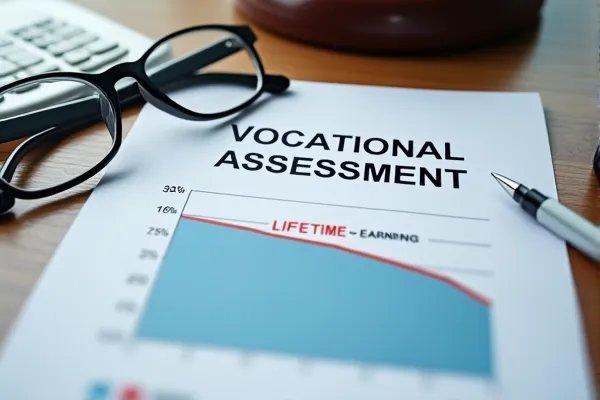
There is a major difference between “Lost Wages” and “Loss of Earning Capacity.” Lost wages are simple math: the days you missed work multiplied by your pay rate. Loss of Earning Capacity is complex. It compensates you for the money you would have earned in the future had the injury not occurred. If a shoulder injury prevents a construction worker from lifting overhead, he loses his career trajectory. We hire Vocational Experts to calculate the “Present Cash Value” of that lifetime loss.

Lost Wages & Future Earnings: getting paid for missed work in San Diego without letting the insurer rewrite your job history?
The single most important rule under California Law is this: wage loss is only as strong as the paper trail and the medical restriction that ties your time off to the injury, not to “choice” or “convenience.” If you don’t lock down that causation early, the defense will treat your income claim as negotiable.
How lost wages really get attacked in a San Diego injury claim
I’ve handled enough cases to know where the wage loss fight starts: it starts the moment an adjuster decides your job is “too complicated” to value. In practice, they pressure you to accept a flat number before your employer’s records and your restrictions are organized, then they later call your income “speculative.” That’s not law. That’s tactics.
In an anonymized San Diego case, the client was a warehouse lead near Otay Mesa who couldn’t perform essential lifting and repetitive tasks for weeks, then returned with reduced hours and no overtime. We filed in San Diego Superior Court because once litigation is real, the defense has to answer for the missing payroll documents, the overtime history, and the claim that “light duty was available.” Wage loss is provable. It just has to be built like evidence, not like a complaint.
My litigation approach on income loss is consistent:
- Medical causation first: restrictions and work status must match the dates of missed work.
- Employer proof second: payroll, schedules, timecards, and policy documents should confirm the loss.
- Reality check third: what your earnings looked like before the crash, including overtime patterns and bonuses.
- Defense-proof presentation: a clean timeline that doesn’t give the insurer room to “re-label” your time off.
Jurisdictional authority: why San Diego Superior Court and California damages law change the wage-loss math
Lost wages and future earnings are compensatory damages governed by Civ. Code § 3333, and future economic loss is explicitly recognized in Civ. Code § 3283. Those statutes sound simple, but the courtroom reality is where your leverage lives.
Venue matters because filing in San Diego Superior Court changes what the defense must do: produce records, answer interrogatories, and commit to positions that can be tested. And none of it matters if you miss the filing deadline under CCP § 335.1.
The “Immediate 5”: lost wage and future earnings questions San Diego victims ask when paychecks stop
1) What documents do I need to prove lost wages in San Diego?
You need proof that is both financial and causal: payroll records (pay stubs, timecards, W-2/1099 history), scheduling/overtime records, and an employer verification that identifies the dates and reason you missed work. The medical side has to match the work side, because wage loss is damages “proximately caused” by the injury under Civ. Code § 3333. If your restrictions are vague, the insurer will argue you could have worked.
2) How do insurers in Southern California minimize overtime, tips, commissions, or variable pay?
They treat variable earnings as “non-guaranteed” and try to value you as if you were a base-rate employee with no history. The fix is evidence: show the pattern (prior pay periods, seasonal peaks, written incentive plans) and connect the disruption to the injury timeline. Future loss becomes especially important when overtime access or performance-based pay is part of your normal earnings, because California law recognizes future damages under Civ. Code § 3283.
3) Can I recover future earnings if I go back to work but can’t do my old job?
Yes, when the injury reduces your earning capacity going forward, even if you’re employed. The question is not “did you return,” it’s “what did the injury take away”: physical capacity, hours, overtime eligibility, promotions, or a higher-paying track. The legal foundation is compensatory damages under Civ. Code § 3333 and recognition of future harm under Civ. Code § 3283, proven through credible work history and medical restrictions.
4) What deadlines apply to wage-loss claims in California?
Lost wages are part of the personal injury case, so the primary time limit is the statute of limitations for injury actions under CCP § 335.1. If you miss that deadline, you don’t “keep the wage claim” separately—your whole civil claim is gone. Practically, waiting also risks losing the best employer records and the cleanest evidence of the initial restrictions.
5) What changes once we file in San Diego Superior Court over lost wages and future earnings?
Filing forces accountability. The defense can’t keep hiding behind “we don’t have enough” while refusing to produce what exists, and your employer records and wage methodology can be locked down in discovery. In San Diego Superior Court, wage loss becomes a document-driven proof problem, not an adjuster’s opinion, and your damages remain anchored to California’s compensatory framework under Civ. Code § 3333.
Before we talk numbers, we build the wage-loss narrative so it survives the usual insurer arguments:
- “You could have worked”: attacked with clear restrictions, job duties, and employer confirmation.
- “Your pay is inconsistent”: answered with historical payroll patterns and policy documents.
- “You used sick time so you didn’t lose anything”: addressed by treating PTO as a depleted benefit with real value.
- “Future loss is speculative”: countered with the injury’s functional limits and work history.
This is how wage loss stops being an argument and becomes evidence.
Magnitude expansion: wage loss isn’t one number, it’s a timeline that must hold up in court
A) Evidence Evaluation in San Diego Cases
Economic loss gets discounted when the evidence looks sloppy. We tighten it like a trial exhibit package.
- Police reports vs medical records: we align the incident date, symptom onset, and restrictions to the missed work dates.
- Scene photos vs repair documentation: we neutralize “minor impact” arguments that insurers use to question disability time.
- Treatment timeline consistency: we protect credibility by matching appointments, work notes, and employer communications.
B) Settlement vs Litigation Reality
Once a case is filed in San Diego Superior Court, the defense has to stop guessing and start producing. Wage loss becomes a question of records, methodology, and causation—backed by Civ. Code § 3333 and the future-damages framework of Civ. Code § 3283.
- Discovery forces the defense to pick a position and live with it.
- Employer documentation becomes harder to dismiss when compelled and authenticated.
- Overreaching hurts, so we keep the claim accurate and provable.
C) San Diego-Specific Claim Wrinkles
San Diego income profiles are diverse: military-adjacent contractors, port and logistics workers, hospitality, and shift-based trades. Each category comes with predictable insurer pressure points.
- Variable schedules and overtime surges get minimized unless you prove the historical pattern.
- Multiple job roles or side gigs get treated like “unverified” income unless documented correctly.
- Common Southern California insurer resistance patterns include early low offers aimed at freezing wage numbers before records are complete.
Lived Experiences
Amy
“I kept getting told my missed work ‘wasn’t confirmed.’ Richard built the timeline with my work records and medical restrictions, and the wage loss finally got treated like a real part of the case.”
Paul
“The adjuster tried to ignore my overtime history. Richard made them look at the actual payroll pattern, and the case stopped being about opinions and became about documents.”
California Statutory Framework & Legal Authority
|
Attorney Advertising, Legal Disclosure & Authorship
ATTORNEY ADVERTISING.
This content is provided for general informational and educational purposes only and does not constitute legal advice.
Under the California Rules of Professional Conduct and applicable State Bar of California advertising regulations,
this material may be considered attorney advertising.
Viewing or reading this content does not create an attorney-client relationship.
Laws and procedures governing personal injury claims vary by jurisdiction and may change over time.
You should consult a qualified California personal injury attorney regarding your specific situation before taking any legal action.
Responsible Attorney:
Richard Morse, California Attorney (Bar No. 289241).
Morse Injury Law is a practice name and location used by Richard Peter Morse III, a California-licensed attorney.
About the Author & Legal Review Process
This article was prepared by the legal editorial team supporting Richard Peter Morse III,
with the goal of explaining California personal injury law and claims procedures in clear, accurate, and practical terms for injured individuals in San Diego and surrounding communities.
Legal Review:
This content was reviewed and approved by Richard Morse, a California-licensed attorney (Bar No. 289241),
who concentrates his practice on personal injury litigation and insurance claim disputes.
With more than 13 years of experience representing injury victims throughout California,
Mr. Morse focuses on serious personal injury matters including motor vehicle collisions, uninsured and underinsured motorist claims,
premises liability, catastrophic injury, and wrongful death.
His practice emphasizes claims evaluation, insurance carrier accountability, and litigation in California courts when fair resolution cannot be achieved.
|