
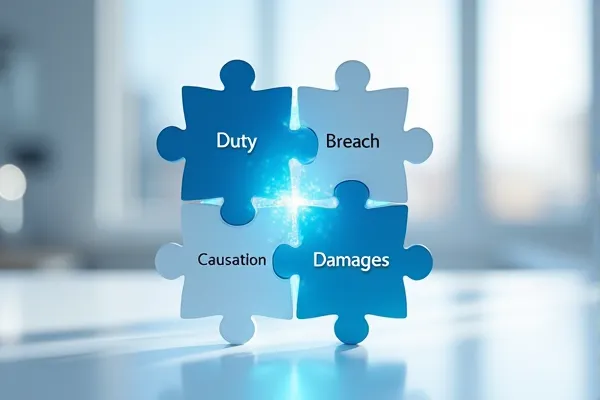
Under Civil Code § 1714(a), everyone is responsible for injuries caused by their “want of ordinary care.” However, simply being involved in an accident is not enough to sue. To have a viable legal case, we must prove the “Four D’s” of negligence: 1) Duty (The driver had a duty to stop at the red light), 2) Dereliction (They breached that duty by texting), 3) Direct Cause (The texting caused the crash, not bad weather), and 4) Damages (You suffered real financial or physical harm). If any one of these elements is missing—especially Damages—there is no case.
Do I have a case in San Diego — and how do I know before the insurance file gets written for me?
The single most important rule under California Law: a “case” is not the same thing as an injury. It’s proof of duty, breach, causation, and damages that would survive scrutiny in a claim file and, if needed, in court.
How I evaluate a “do I have a case?” question in San Diego, in the real world
If your situation ends up in litigation, it lands in San Diego Superior Court, and the question becomes whether your evidence can carry the burden. Under California Law, the baseline negligence duty is framed by Civ. Code § 1714, and damages are generally measured by the harm caused under Civ. Code § 3333.
An anonymized San Diego scenario I see all the time: a rear-end chain on I-15, a short ER visit, then a gap in care because the person tries to “tough it out.” The insurer later argues the gap proves the injury wasn’t serious and pushes a small number before the medical story is fully documented. The strategy is straight: tighten the treatment timeline, document mechanism with photos/repairs/witnesses, and keep statements consistent so causation doesn’t get re-litigated inside the adjuster’s notes.
Insurance companies don’t deny cases by saying “we don’t believe you.” They deny or discount by saying “you can’t prove it,” and they do it using timelines, inconsistencies, and missing documentation.
Why California venue and San Diego Superior Court reality matter to your “case”
In San Diego, the practical question is whether your claim can be presented cleanly enough to be filed and litigated if the carrier refuses to behave. The general deadline to file most personal injury lawsuits is two years under CCP § 335.1, but evidence quality drops long before the statute runs.
Fault also isn’t always binary. Comparative fault is baked into California practice under Civ. Code § 1431.2, and insurers use that reality to shave value even when you were mostly right. Venue matters because once a file is built for San Diego Superior Court, vague excuses tend to get less traction.
The “Immediate 5” questions that tell me whether you likely have a real San Diego injury case
1) What facts do I need to prove to have a personal injury “case” under California Law?
You need evidence that someone failed to use reasonable care (duty and breach) as framed by Civ. Code § 1714, and that their conduct caused actual damages. You also need damages that can be proven and valued, generally measured under Civ. Code § 3333. In San Diego, the “case” becomes real when the documentation is strong enough that an adjuster can’t plausibly write it off as noise.
2) What if I’m partly at fault — does that mean I don’t have a case?
Not automatically. California applies comparative fault principles, and liability can be allocated across parties; in practice, insurers will argue percentages to reduce payout. California’s allocation framework is reflected in Civ. Code § 1431.2, and it becomes leverage once the evidence shows the other side’s conduct was the primary cause. In a San Diego claim, partial fault is a valuation problem, not an automatic “no case” answer.
3) How much time do I have to decide if I’m going to pursue this?
The outer deadline for filing most personal injury actions is two years under CCP § 335.1. But insurers often gain advantage much earlier by letting evidence fade and by using gaps in medical care to argue the injury wasn’t caused by the incident. If you want a real answer on “do I have a case,” the timing has to support proof, not just the calendar.
4) What kinds of evidence make a San Diego case stronger or weaker?
Strong cases usually have consistent medical documentation and clear mechanism proof: scene photos, vehicle damage documentation, witness information, and a treatment timeline that matches the injury. Weak cases often have recorded statements that minimize symptoms, long gaps in care, or a paper trail that doesn’t line up with causation and damages under Civ. Code § 3333. Under Civ. Code § 1714, the “reasonable care” story must be provable, not just believable.
5) What if the insurance company is “investigating” or denying responsibility?
That’s normal, especially when multiple policies or parties are involved, and it’s why the file has to be built like litigation may happen. The practical move is to treat the case as if it may be filed in San Diego Superior Court and make sure liability and damages proof is organized early. If you wait until the last minute under CCP § 335.1, you’ve already ceded leverage that doesn’t come back.
“Do I have a case?” is really three questions: can we prove fault, can we prove causation, and can we prove damages in a way that forces the carrier to take the claim seriously.
If any one of those pillars is thin, the solution is usually evidence discipline and timeline control, not louder arguing.
Magnitude expansion: the three proof pillars I pressure-test before I ever call something a “case”
A) Evidence Evaluation in San Diego Cases
I pressure-test whether the story can be proven without relying on vibes. In practice, that means aligning liability under Civ. Code § 1714 with the documentation that actually exists.
- Police reports vs medical records: reports help, but consistent medical notes often carry more weight on injury and timing.
- Scene photos vs repair documentation: photos show positions and conditions; repairs corroborate force and sequence.
- Treatment timeline consistency: gaps become insurer talking points; continuity reduces causation attacks.
- Witness reliability: names and numbers early beat “I think someone saw it” later.
B) Settlement vs Litigation Reality
Pre-suit, insurers can “investigate” forever. Post-filing, procedure imposes structure, and a case with clean proof becomes harder to stall. The statute of limitations under CCP § 335.1 is the legal boundary, but discovery and trial readiness are the leverage drivers.
When a file is built like it could be tried, settlement becomes a rational business decision for the carrier. When it’s built like a complaint letter, they price it like noise.
C) San Diego-Specific Claim Wrinkles
San Diego cases have predictable friction points: freeway rear-end chains, rideshare overlap, and multi-vehicle disputes where everyone points everywhere. Carriers also lean into comparative fault arguments, which is why the allocation reality under Civ. Code § 1431.2 matters on day one.
- Traffic density and rear-end patterns: chain collisions turn into sequence fights—capture details early.
- Multi-vehicle freeway collisions: the “who hit who first” timeline decides liability allocation.
- Common insurer resistance patterns: “gap in care,” “minimal damage,” and “pre-existing” are standard discount tools.
Lived Experiences
Isaac
“I kept asking ‘do I have a case’ and nobody gave me a straight answer. Richard broke it down to proof and timelines, and once we fixed the documentation issues, the insurer stopped acting like my injury was optional.”
Leah
“The adjuster kept pushing me to say I was okay on a recorded call. Richard’s approach was calm and practical: don’t guess, don’t minimize, and build the file like it might be filed in San Diego Superior Court. That changed the whole tone of the negotiations.”
California Statutory Framework & Legal Authority
|
Attorney Advertising, Legal Disclosure & Authorship
ATTORNEY ADVERTISING.
This content is provided for general informational and educational purposes only and does not constitute legal advice.
Under the California Rules of Professional Conduct and applicable State Bar of California advertising regulations,
this material may be considered attorney advertising.
Viewing or reading this content does not create an attorney-client relationship.
Laws and procedures governing personal injury claims vary by jurisdiction and may change over time.
You should consult a qualified California personal injury attorney regarding your specific situation before taking any legal action.
Responsible Attorney:
Richard Morse, California Attorney (Bar No. 289241).
Morse Injury Law is a practice name and location used by Richard Peter Morse III, a California-licensed attorney.
About the Author & Legal Review Process
This article was prepared by the legal editorial team supporting Richard Peter Morse III,
with the goal of explaining California personal injury law and claims procedures in clear, accurate, and practical terms for injured individuals in San Diego and surrounding communities.
Legal Review:
This content was reviewed and approved by Richard Morse, a California-licensed attorney (Bar No. 289241),
who concentrates his practice on personal injury litigation and insurance claim disputes.
With more than 13 years of experience representing injury victims throughout California,
Mr. Morse focuses on serious personal injury matters including motor vehicle collisions, uninsured and underinsured motorist claims,
premises liability, catastrophic injury, and wrongful death.
His practice emphasizes claims evaluation, insurance carrier accountability, and litigation in California courts when fair resolution cannot be achieved.
|