
For decades, California victims were limited to $250,000 in pain and suffering, regardless of the tragedy.
Effective January 1, 2023, Assembly Bill 35 raised these caps.
Current Non-Economic Caps (2026):
• Non-Death Cases: Limit raised to $390,000 (increasing annually).
• Wrongful Death: Limit raised to $550,000 (increasing annually).
Note: These caps only apply to “Pain and Suffering.” There is no limit on your past and future medical bills or lost wages.
MICRA non-economic damage limits in San Diego: what you must do first under California Law
The single most important rule: don’t let the cap conversation become a shortcut for denying fault. Under California Law, the MICRA cap limits non-economic damages in medical negligence cases, but it does not erase liability, does not cap medical bills, and does not cap lost income.
If the defense frames your case as “only pain and suffering,” they’re steering you away from the damage categories that actually move the number.
What AB 35 changed in real San Diego med-mal cases
I’ve handled these cases long enough to recognize the pattern: the “cap” letter arrives early, before your records are even complete, and it’s designed to anchor you to the lowest valuation. In San Diego Superior Court, that anchor matters—because once a complaint is filed, everyone’s posture changes and the paper trail starts to control the story.
Here’s a realistic San Diego scenario: a patient has a post-op injury, the charting is inconsistent, and the insurer pushes a fast settlement by over-emphasizing the MICRA cap and under-emphasizing future care and wage loss. The strategy is simple: lock down causation proof, preserve the timeline, and force the defense to deal with economic damages and credibility exposure—not just the cap.
- Step one: build the medical chronology (what happened, when, and who documented it).
- Step two: quantify economic damages with real records (wage documents, billing, and treating-provider projections).
- Step three: use litigation pressure points in San Diego Superior Court to force a risk-based evaluation.
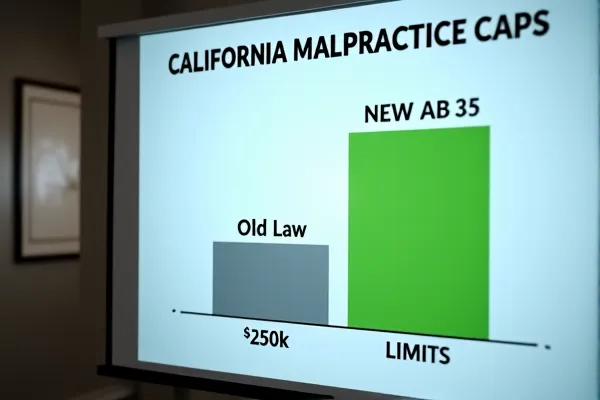
AB 35 didn’t “remove MICRA.” It modernized it. The non-economic cap now increases on a schedule, and the attorney fee limits in medical negligence matters were updated so the economics of taking a hard case to the mat are different than they were under the old structure.
When the defense says “MICRA makes your case small,” my job is to make sure your damages are categorized correctly and proved correctly—because caps don’t change facts, and caps don’t excuse sloppy causation arguments.
Why California Law and San Diego Superior Court venue change leverage
California med-mal is not a “generic injury claim.” The rules are statute-driven, and the venue matters. In San Diego Superior Court, the defense adjusts when they see you’re prepared to litigate: written discovery, depositions, motion practice, and expert work create accountability that doesn’t exist in pre-suit back-and-forth.
The MICRA cap (Civil Code § 3333.2) is real—but so is the exposure on economic damages when the medical record supports causation and the life impact is documented with competent treating testimony and records-backed wage loss.
The “Immediate 5” questions I hear from San Diego patients about MICRA and AB 35
1) What is the MICRA cap on non-economic damages right now, and does it change every year?
In California medical negligence cases, Civil Code § 3333.2 caps non-economic damages (pain, suffering, emotional distress, loss of enjoyment) and the cap now increases annually under AB 35’s schedule. For 2026, the cap is $470,000 for non-fatal injury claims and $650,000 for wrongful death claims, and the cap continues to rise each year until it reaches the scheduled maximums.
2) Does the cap limit my medical bills, lost wages, or future care costs?
No. The MICRA cap in Civil Code § 3333.2 applies to non-economic damages only. Economic damages—past and future medical expenses, wage loss, loss of future earning capacity, and other out-of-pocket losses—are not capped by that statute and are driven by proof, records, and credible causation evidence.
3) Does MICRA apply if the case involves gross negligence or “reckless” conduct?
In a professional negligence action against a health care provider, the non-economic cap in Civil Code § 3333.2 still applies to non-economic damages even when the facts are ugly. What changes is leverage: reckless conduct can strengthen liability proof, increase the perceived trial risk, and expand the economic damages narrative if future care and work limitations are documented.
4) How do attorney fees work after AB 35 in a California medical negligence case?
Business and Professions Code § 6146 sets the contingency fee limits in medical negligence matters. Under the AB 35 update effective January 1, 2023, an attorney generally may not contract for or collect more than 25% of the recovery if the case resolves before a complaint or arbitration demand is filed, and 33% after filing, with a possible motion for a higher fee in tried or arbitrated cases based on good cause.
5) What deadlines can quietly kill a San Diego med-mal case even if liability is strong?
Medical malpractice claims have specialized time limits under Code of Civil Procedure § 340.5, which can run based on the date of injury and the date you discovered (or reasonably should have discovered) the injury. If you miss the controlling deadline, San Diego Superior Court can dismiss the case regardless of how clear the negligence looks on paper.

How I pressure-test proof and value in San Diego
A) Evidence Evaluation in San Diego Cases
- Hospital records vs. what was actually said: charting often smooths over uncertainty; the timeline and note-to-note inconsistencies matter.
- Imaging and labs vs. narrative: objective findings can confirm timing and mechanism—or expose alternative explanations the defense will exploit.
- Treatment timeline consistency: delays and gaps are predictable; I address them directly so the insurer can’t weaponize them.
- San Diego claims handling reality: carriers push “cap-first” valuations early; complete records and causation clarity are what break that tactic.
B) Settlement vs Litigation Reality
Once a case is filed in San Diego Superior Court, the defense has to answer discovery, show their work, and live under court deadlines. That changes leverage. It also changes risk: experts become necessary, and credibility issues that can be ignored pre-suit become expensive problems in litigation.
- Discovery obligations: positions harden, testimony gets locked, and inconsistencies stop being “miscommunications.”
- Leverage: the insurer’s evaluation becomes less about adjuster preference and more about trial exposure.
- Risk: proof burdens and causation fights sharpen—so the case must be built with discipline.
C) San Diego-Specific Claim Wrinkles
- Provider networks: multiple departments and handoffs mean more witnesses, more documentation points, and more places for the defense to “blame the other team.”
- Insurer resistance patterns: early “MICRA cap” letters, causation disputes, and “pre-existing condition” arguments show up fast in Southern California claims.
- Venue reality: San Diego juries and judges see a lot of complex cases; credibility and clean proof matter more than slogans.
Lived Experiences
Gabrielle
“The insurer kept repeating ‘MICRA’ like it ended the conversation. Once Richard mapped out the wage loss and future care with actual records, the tone changed—suddenly they were negotiating the facts instead of reciting a cap.”
Dustin
“I thought my case was ‘small’ because of the non-economic limit. Richard treated it like a trial file from day one, and the settlement finally reflected the months of recovery and what I lost at work—without empty promises.”
California Statutory Framework & Legal Authority
|
Attorney Advertising, Legal Disclosure & Authorship
ATTORNEY ADVERTISING.
This content is provided for general informational and educational purposes only and does not constitute legal advice.
Under the California Rules of Professional Conduct and applicable State Bar of California advertising regulations,
this material may be considered attorney advertising.
Viewing or reading this content does not create an attorney-client relationship.
Laws and procedures governing personal injury claims vary by jurisdiction and may change over time.
You should consult a qualified California personal injury attorney regarding your specific situation before taking any legal action.
Responsible Attorney:
Richard Morse, California Attorney (Bar No. 289241).
Morse Injury Law is a practice name and location used by Richard Peter Morse III, a California-licensed attorney.
About the Author & Legal Review Process
This article was prepared by the legal editorial team supporting Richard Peter Morse III,
with the goal of explaining California personal injury law and claims procedures in clear, accurate, and practical terms for injured individuals in San Diego and surrounding communities.
Legal Review:
This content was reviewed and approved by Richard Morse, a California-licensed attorney (Bar No. 289241),
who concentrates his practice on personal injury litigation and insurance claim disputes.
With more than 13 years of experience representing injury victims throughout California,
Mr. Morse focuses on serious personal injury matters including motor vehicle collisions, uninsured and underinsured motorist claims,
premises liability, catastrophic injury, and wrongful death.
His practice emphasizes claims evaluation, insurance carrier accountability, and litigation in California courts when fair resolution cannot be achieved.
|